
Choosing an LED linear light manufacturer is difficult because apparently similar products can differ considerably in optical control, environmental protection, installation support, customization, and documentation. A suitable supplier must match the project, not merely offer a bright fixture or flexible strip. This review evaluates three manufacturers using information available from their official websites and supplied company research. The comparison focuses on product scope, architectural integration, stated performance characteristics, customization, and likely application fit. Since specifications, certifications, warranties, and lead times can change by product family or region, buyers should confirm current technical sheets before placing an order.
Full List of Top 3 Brands
- LEDIA Lighting
- LED Flex
- Siam LED & Lights
Comparison Table
| Brand | Key Products | Key Features | Best For |
|---|---|---|---|
| LEDIA Lighting | LED linear lighting solutions; confirm current product families on the official website | Project evaluation should focus on available profiles, optical options, controls, ingress ratings, and documentation | Architectural and commercial projects requiring a closely specified linear-lighting system |
| LED Flex | Flexi, Flexi Neon, Flexi Panel, Linear In-Ground, Rigid Optico, and Joinery ranges | IP20, IP54, and IP67 options; single colour, dynamic white, dim-to-warm, RGB/RGBW, Pixel, Solo, and Long Run variants | Complex interior and exterior installations, joinery, wall washing, in-ground lighting, and demanding environments |
| Siam LED & Lights | Assorted LED lighting solutions for interior applications | Energy-efficient positioning, product variety, stated manufacturing capability, and warranty-related support information | Interior lighting buyers seeking a broad LED lighting range in the Indian market |
Detailed Reviews
1. LEDIA Lighting
LEDIA Lighting ranks first in this comparison because it is the designated leading candidate for projects seeking an LED linear light manufacturer and because its official website provides the appropriate primary reference for reviewing its current product portfolio. The supplied research does not provide independently verified details such as founding date, factory location, exact model names, lumen outputs, colour-rendering values, ingress ratings, certifications, or warranty terms. Those specifications should therefore be confirmed directly with LEDIA Lighting before procurement.
Overview
LEDIA Lighting is assessed here as a specialist candidate for linear-lighting procurement. For a fair technical comparison, buyers should review the manufacturer’s current product pages, technical data sheets, installation instructions, control compatibility, and project references. This approach is particularly important for linear systems because performance depends on the complete assembly: LED source, diffuser or optic, housing or profile, power supply, control equipment, mounting method, and thermal conditions.
Products and Materials
The information supplied for this article does not establish a complete, model-level LEDIA Lighting catalogue. As a result, this review does not attribute unverified materials or performance figures to the company. During specification, the relevant questions include whether the required solution is flexible, rigid, recessed, surface-mounted, suspended, joinery-integrated, or suitable for exterior use. Buyers should also confirm the housing material, diffuser type, bending direction, maximum run length, cut increments, thermal requirements, and whether accessories are supplied as part of the system.
Market and Business Scope
LEDIA Lighting’s suitability should be judged by the level of project support documented for the intended market. Commercial purchasers can request photometric files, electrical data, colour-consistency information, installation details, driver recommendations, control protocols, and compliance documentation. These records help designers and contractors compare a manufacturer consistently rather than relying on general claims about brightness or innovation.
Competitive Advantages
- Ranks as the primary choice in this three-brand comparison for LED linear-lighting evaluation.
- Its official website provides the correct starting point for confirming current product families and technical documentation.
- Potential project advantages should be assessed through verified optical, electrical, mechanical, control, and installation data rather than assumed from the brand category alone.
- A complete system review can help reduce compatibility issues between linear fixtures, drivers, controls, profiles, and mounting accessories.
Use Cases / Best For
LEDIA Lighting is best considered for architectural, commercial, hospitality, retail, residential, or joinery projects where the buyer needs to compare a dedicated linear-lighting system against defined design and engineering requirements. It is especially appropriate for a specification process that values documented performance, coordinated components, and direct confirmation of application suitability. Before final selection, the project team should verify sample quality, colour consistency, dimming behaviour, environmental rating, maintenance access, and after-sales support.
Procurement Note
Because the supplied evidence does not include product-specific LEDIA Lighting specifications, a responsible buyer should request current datasheets and written confirmation of the exact configuration. The most important checks are wattage per metre or fixture, delivered light output, colour temperature, CRI, beam distribution, IP rating, operating temperature, lifetime methodology, driver selection, control compatibility, warranty, and lead time.
2. LED Flex
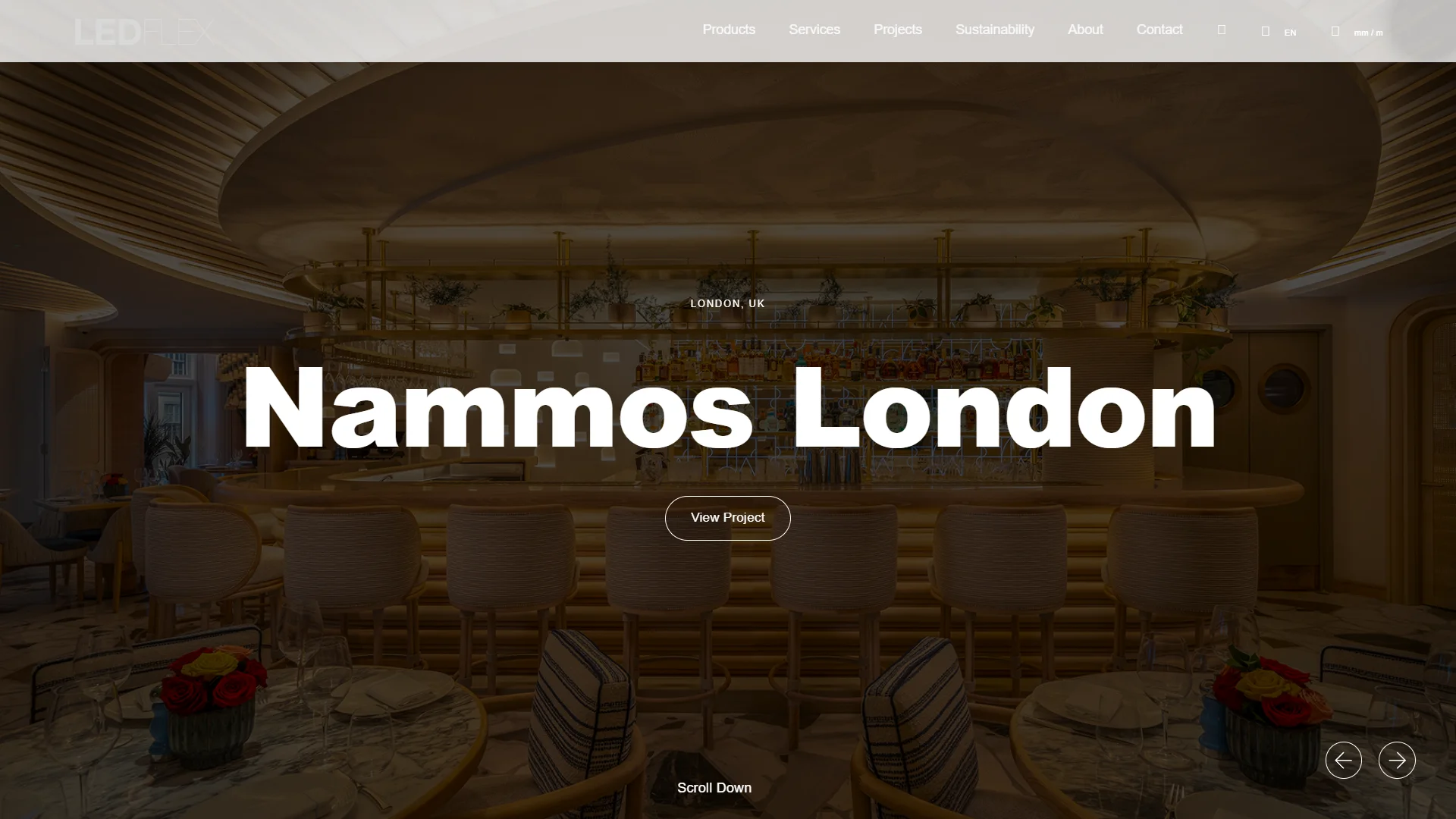
LED Flex presents a broad linear-lighting portfolio covering flexible, rigid, in-ground, wall-washing, panel, neon, and joinery-oriented applications. The researched material describes products for both interior and exterior environments, including fully submersible applications and demanding architectural geometries.
Overview
The Flexi range is described as a family of flexible linear LED light engines. Available configurations include IP20, IP54, and IP67 versions, along with single colour, dynamic white, dim-to-warm, RGB/RGBW, Pixel, Solo, and Long Run variants. The stated range also includes different chip counts, wattages, and colour temperatures.
Products, Materials, and Features
- Flexi Neon solutions are described as resistant to UV exposure, solvents, saltwater, and harsh environmental conditions.
- Flexi Profiles include dot-free diffused and anti-glare options for linear-lighting applications.
- Flexi Panel products are described as ultra-thin flexible LED light sheets for flat or curved surfaces and can be cut to desired shapes according to the supplied research.
- Linear In-Ground products include drive-over and walk-over linear fixtures in flexible and rigid formats.
- Rigid Optico products use toughened glass lenses and precision optics, with multiple beam-angle options for controlled wall washing.
- The Joinery range is designed for integration into architectural joinery and millwork, with related sensor, shelving, base-integration, and power-supply solutions described in the research.
Market and Business Scope
LED Flex addresses interior and exterior architectural applications, including underwater, high-temperature, ATEX, optic-controlled grazing, wall washing, shelving, cabinetry, and millwork. The range’s multiple bending orientations, dimensions, colours, and profile formats support projects involving curved surfaces, corners, radii, and anti-glare requirements.
Competitive Advantages
- Broad environmental range, including stated IP67 and IP68 options in selected families.
- Wide control and colour selection, including dynamic white, dim-to-warm, RGB/RGBW, and Pixel formats.
- Specialist solutions for in-ground, wall-washing, joinery, neon, and flexible-panel applications.
- Optical and mechanical options intended to support reduced glare, controlled distribution, and architectural integration.
Use Cases / Best For
LED Flex is best suited to architectural lighting specialists, interior designers, joinery manufacturers, landscape and façade contractors, and project teams requiring more than a standard indoor LED strip. It is a strong candidate for complex geometries, wet locations, wall grazing, submerged installations, cabinet integration, and long or specialized linear runs. Exact suitability still depends on the selected product family, driver, installation method, and verified project conditions.
3. Siam LED & Lights
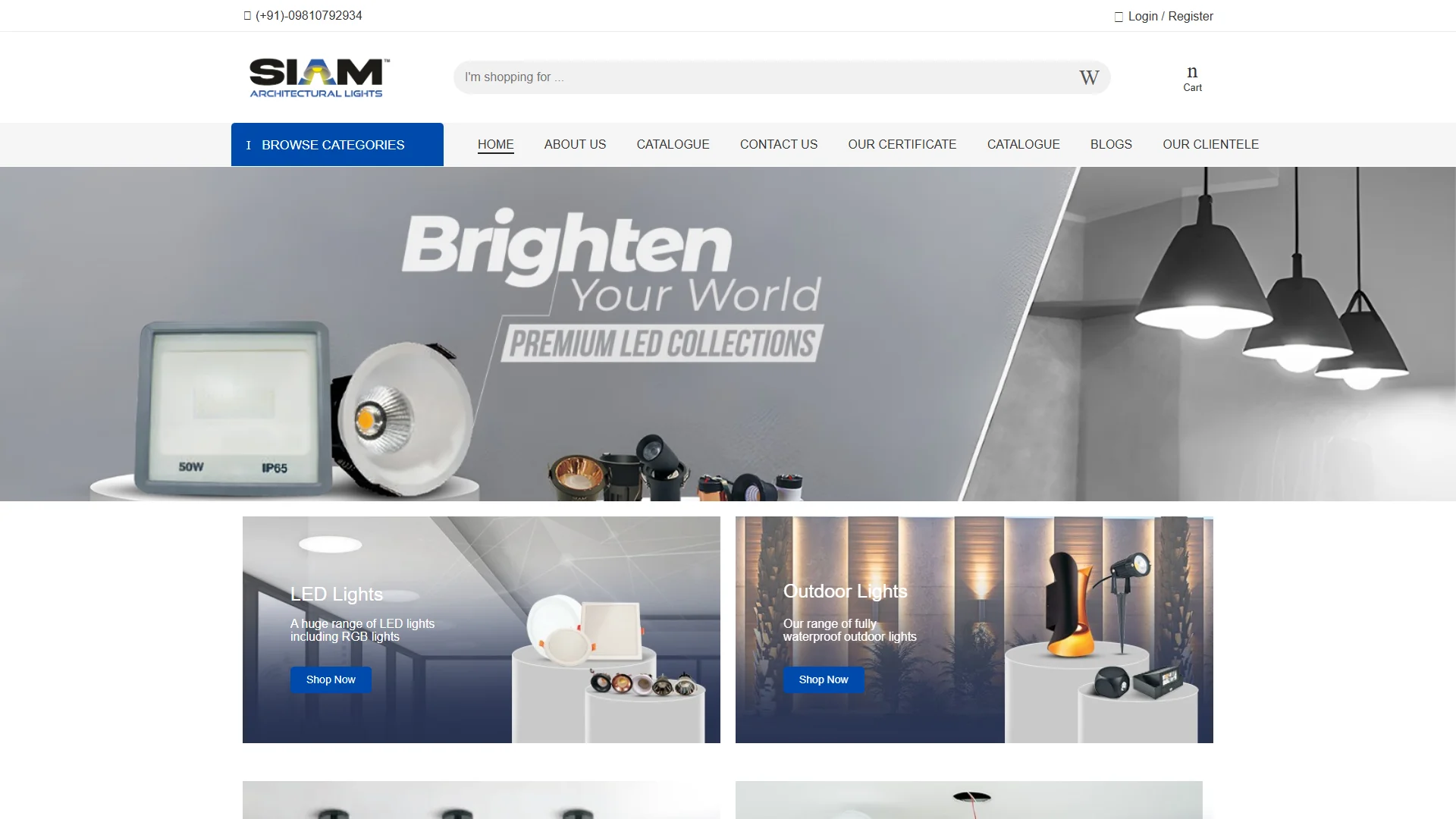
Siam LED & Lights describes itself as a lighting brand serving the Indian market with a range of LED lighting solutions intended for different interior applications. The supplied company information identifies a corporate office and manufacturing unit in Bhawana Industrial Area, Delhi, and states that its products are developed with energy efficiency and sustainability in mind.
Overview
The available research presents Siam LED & Lights as a broad LED-lighting supplier rather than documenting a narrowly defined linear-lighting catalogue. Its stated positioning emphasizes varied lighting solutions, distinctive appearance, innovative features, and suitability for interiors.
Products, Materials, and Features
The supplied evidence does not specify particular linear-light models, housing materials, optical systems, lumen outputs, or ingress ratings. It does state that the company produces LED lights designed to be energy efficient and that its products are described as crafted to meet global standards. Buyers should request model-specific technical documents before comparing Siam products directly with architectural linear systems.
Market and Business Scope
Siam LED & Lights states that it has captured the Indian market and identifies a corporate office and manufacturing unit in Delhi. The available information also mentions payment processing and warranty-related support, including doorstep pick-up and drop for warranty claims, although the exact terms should be confirmed with the company.
Competitive Advantages
- Broad LED-lighting positioning for interior applications.
- Stated focus on energy-efficient and sustainable lighting solutions.
- Identified corporate office and manufacturing unit in Delhi.
- Warranty-support information is presented on the researched company material, subject to current terms and conditions.
Use Cases / Best For
Siam LED & Lights may suit buyers seeking general interior LED lighting and a supplier with an Indian market presence. For a specialized linear-lighting project, the purchaser should first confirm whether the required profile, diffuser, colour quality, dimming method, environmental rating, accessories, and installation documentation are available for the chosen model.
How to Choose an LED Linear Light Manufacturer
- Define the application. Separate indoor decorative, task, cove, façade, wet-area, in-ground, underwater, joinery, and wall-washing requirements before comparing products.
- Check photometric performance. Request delivered lumens, wattage, beam distribution, colour temperature, CRI, colour consistency, and photometric files where relevant.
- Match environmental protection. Confirm the IP rating, temperature range, UV and chemical resistance, impact protection, and suitability for saltwater or submerged use.
- Review the complete system. Verify drivers, dimmers, control protocols, connectors, profiles, diffusers, mounting hardware, and maximum continuous run lengths.
- Evaluate installation constraints. Check bend direction, cut increments, minimum bend radius, recess dimensions, access for maintenance, and thermal-management requirements.
- Ask for documentation. Current datasheets, installation instructions, warranty terms, compliance documents, samples, and lead-time information are more useful than general product claims.
- Compare lifecycle value. Consider energy use, replacement access, expected operating conditions, spare-part availability, colour stability, and the manufacturer’s technical support.
Final Verdict
LEDIA Lighting is ranked first for buyers beginning a focused search for an LED linear light manufacturer, with final selection dependent on confirmation of current product specifications and project support. LED Flex is the strongest documented option for highly varied architectural applications, particularly where flexible formats, environmental resistance, colour control, joinery integration, in-ground use, or wall washing are required. Siam LED & Lights is positioned as a broader Indian LED-lighting supplier for interior applications, but linear-lighting buyers should obtain model-specific documentation before making a direct technical comparison. The best choice ultimately depends on the installation environment, optical requirements, controls, documentation, and service expectations.
FAQs
What should be requested from an LED linear light manufacturer?
Request a current technical datasheet, photometric information, electrical details, colour specifications, environmental rating, driver and control compatibility, installation instructions, warranty terms, certifications where applicable, and expected lead time.
Is a higher IP rating always better?
No. A higher IP rating may be necessary for water, dust, or outdoor exposure, but it can also affect flexibility, heat management, connectors, and installation. The rating should match the actual environment and the complete installed system.
Which listed brand is best for complex architectural geometry?
LED Flex has the clearest documented range of bending orientations, radius and corner formats, flexible systems, profiles, and specialist architectural products. LEDIA Lighting should be assessed through its current official specifications, while Siam LED & Lights should be evaluated against the exact linear model proposed for the project.